This year’s World Stroke Day theme is “Every M1nute Counts.” It’s a call to know the signs of stroke and act fast.
Acting fast matters. So does knowing what works before and after a stroke. For nearly three decades, PHRI researchers have been working on that. Who is at risk? Can a warning sign be caught sooner? What lowers the chance of a stroke, and of a second one?
This article highlights nine of PHRI’s published studies. Each helped fill a gap in the evidence or tested a new approach. Around 100,000 people took part, in Canada and around the world.
Who is most at risk?
Most people can’t see their own risk of stroke coming. The INTERSTROKE study compared nearly 27,000 people in 32 countries, looking at who had strokes and why. Researchers found that 10 risk factors that can potentially be changed were together linked to about 90 per cent of stroke risk, in every major region of the world. The factors are high blood pressure, regular physical activity (linked to lower risk), a healthier diet (also linked to lower risk), blood fats, waist-to-hip ratio, psychosocial factors such as stress, smoking, heart conditions, alcohol intake and diabetes.
One factor stood out. A history of high blood pressure, or a reading of 140/90 or higher, was linked to 47.9 per cent of stroke risk, more than any other. Published in The Lancet. Co-led by Martin O’Donnell, PHRI senior international fellow, and Salim Yusuf, PHRI founder and emeritus executive director and senior scientist.
Can a warning sign be caught early?
Doctors can’t always find what caused a stroke. Researchers wondered whether a heart rhythm problem that people never notice could play a part.
Atrial fibrillation is an irregular heartbeat that raises the risk of stroke. In the ASSERT study, 2,580 people aged 65 and older, all with high blood pressure and no known atrial fibrillation. For three months, the devices watched for short bursts of very fast beating in the heart’s upper chambers. About one in 10 people had them.
Over 2.5 years, those people had about 2.5 times the risk of a stroke caused by a clot, or a clot elsewhere in the body. The result raised an obvious question. Should these quiet episodes be treated? Published in NEJM. Led by Jeff Healey, senior scientist, and the late Stuart Connolly.
ARTESiA took up that question. The study ran for eight years at 288 sites in 16 countries. It followed 4,012 people whose implanted devices had picked up symptom-free episodes. All had other risk factors for stroke.
Some took apixaban, a widely available blood thinner. Others took aspirin. Apixaban cut the risk of a stroke or a clot elsewhere in the body by 37 per cent. It cut the risk of a fatal or disabling stroke by 49 per cent.
Major bleeding was more common on apixaban, at 1.71 per cent a year versus 0.94 per cent. “While we found an increase in major bleeding, this non-fatal bleeding is usually reversible and most patients recover from it,” said Healey, co-principal investigator of the study. Published in NEJM. Co-led by Healey, Connolly and Renato Lopes of Duke University.
Lowering the risk
Can a heart medicine help the brain?
Not every stroke finding comes from a stroke study. In HOPE, 9,297 people aged 55 or older took either the heart and blood pressure medicine ramipril, or a placebo. All had heart or blood vessel disease, or diabetes plus another risk factor. None were known to have heart failure.
Stroke was one of three events tracked, along with heart attack and death from heart or blood vessel causes. Over about five years, stroke happened in 3.4 per cent of people on ramipril and 4.9 per cent on the placebo. Published in NEJM. Study was led by Yusuf.
What if the usual treatment isn’t an option?
Warfarin is a common treatment for people with atrial fibrillation, but it doesn’t suit everyone. In AVERROES, 5,599 people were unsuitable for warfarin-type drugs. All had atrial fibrillation and a higher risk of stroke. They took either apixaban or aspirin.
A stroke or a clot elsewhere in the body happened in 1.6 per cent a year of those on apixaban. It happened in 3.7 per cent a year of those on aspirin. The trial was stopped early because the benefit was clear. Major bleeding was not significantly different between the groups. Published in NEJM. Study was led by Connolly and John Eikelboom, PHRI senior scientist.
A different risk for people with narrowed arteries
People with narrowed arteries in the heart or legs face their own risk. In COMPASS, 27,395 people took one of three treatments.
Those who took a low dose of a blood thinner called rivaroxaban plus aspirin had fewer heart attacks, strokes and deaths from heart or blood vessel causes than those on aspirin alone: 4.1 per cent versus 5.4 per cent. They also had more serious bleeding: 3.1 per cent versus 1.9 per cent. Rivaroxaban on its own did not do significantly better than aspirin. Published in NEJM. Study co-led by Eikelboom, Sonia Anand, senior scientist, and Connolly.
Can surgeons help while they are already operating?
Sometimes the chance comes while a patient is already on the operating table. Clots can form in a small pouch of the heart called the left atrial appendage. In the LAAOS III trial, 4,770 people with atrial fibrillation and an increased risk of stroke were having heart surgery for another reason. During surgery, about half had the pouch closed off, and half did not.
Over an average of nearly four years, 4.8 per cent of those with the pouch closed had an ischemic stroke (including a mini-stroke that shows up on brain scans) or a clot elsewhere in the body. That compares with 7.0 per cent of the others. It’s a 33 per cent drop. After the first 30 days following surgery, the drop was 42 per cent.
Most people kept taking blood thinners. Bleeding around the time of surgery, heart failure and death did not differ significantly between the groups. The closure worked alongside blood thinners, not in place of them. Published in NEJM. Co-led by Richard Whitlock, PHRI senior scientist and Connolly.
Preventing a second stroke
Sometimes a stroke looks as if it came from a clot that travelled to the brain, but no source can be found. That’s known as an embolic stroke of an undetermined source. NAVIGATE ESUS tested whether a blood thinner could prevent a second one.
In total, 7,213 people who had recently had this kind of stroke took either rivaroxaban or aspirin. The trial stopped early, after about 11 months. Rivaroxaban wasn’t showing a benefit, and it was causing more bleeding.
Another stroke or clot elsewhere in the body happened at a rate of 5.1 per cent a year on rivaroxaban and 4.8 per cent a year on aspirin. That difference was not significant. Major bleeding was 1.8 per cent a year versus 0.7 per cent. A stronger-sounding drug isn’t always a better one. Published in NEJM. Co-led by Robert Hart and Connolly.
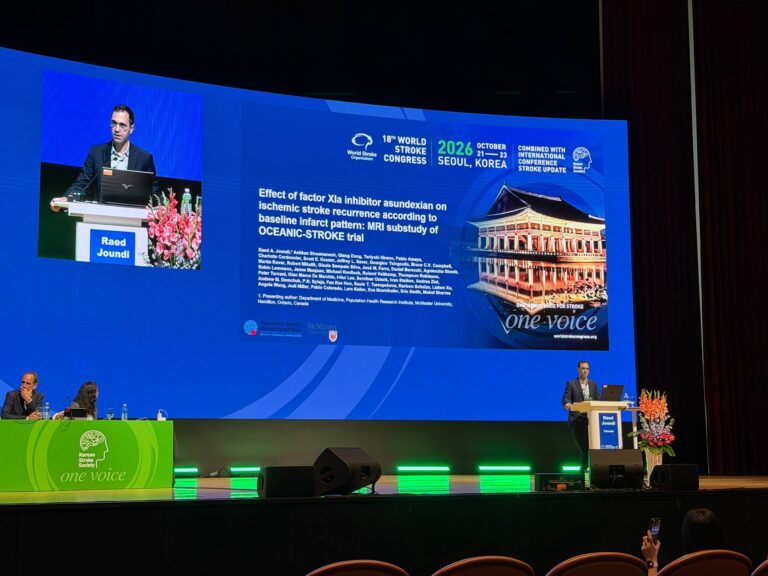
The newest result comes from OCEANIC-STROKE. It involved 12,327 adults in 37 countries. All were enrolled within 72 hours of an ischemic stroke not caused by a clot from the heart, or a high-risk mini-stroke.
Participants took the investigational drug asundexian once a day, or a placebo. Both groups also took standard antiplatelet treatment, such as aspirin.
Over about 19 months, another ischemic stroke happened in 6.2 per cent of people on asundexian and 8.4 per cent of people on the placebo. Major bleeding was similar: 1.9 per cent and 1.7 per cent. Asundexian isn’t approved for use yet. Published in NEJM. Co-led by Mike Sharma and Ashkan Shoamanesh, PHRI senior scientists.
What comes next: recovery
The questions don’t stop when the immediate danger passes. PROSPECT, led by PHRI scientist Raed Joundi and Sharma, is enrolling up to 10,000 adults in 11 countries within 16 weeks of a stroke.
Researchers will follow them for up to five years to learn how their thinking, daily function and quality of life change, and why some people recover better than others. The study is ongoing.
Thank you
None of this happens without the people who said yes. To every participant, and to the hospital staff, coordinators and researchers who followed each study through, thank you.
Know the signs of stroke: face drooping, arm weakness, speech trouble. Time to call 9-1-1.
Results apply to the groups studied. Anyone with questions about their own risk or treatment should talk to a health-care provider.